The Engineer Who Did the Math Again
A quantum error correction theorist publishes a landmark paper arguing the overhead makes fault tolerance impractical. Then the data starts moving — and she applies the same rigor that produced the original argument to decide whether she was wrong.
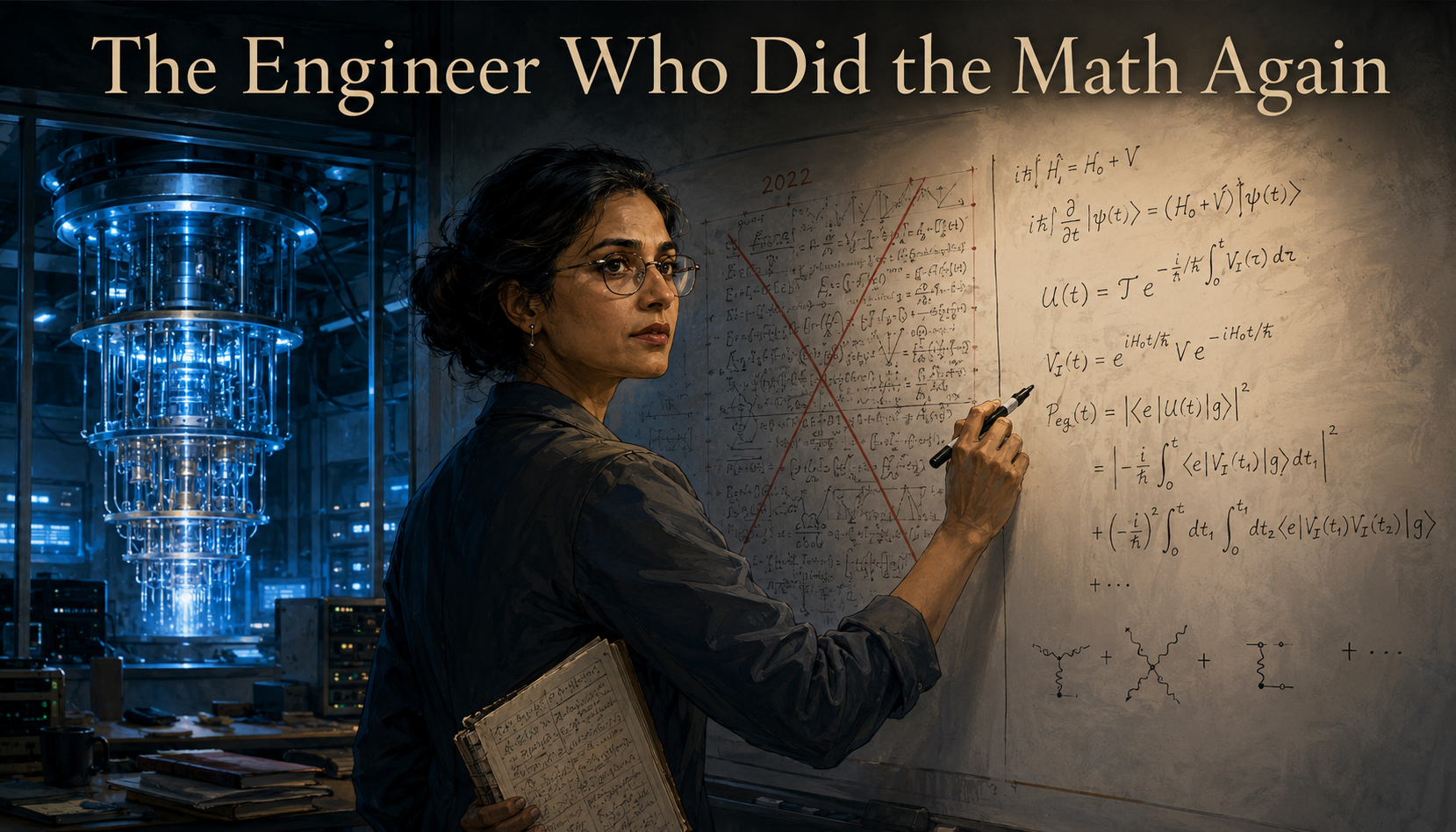
Cover Image
Generate a wide-landscape graphic novel cover image with a width:height ratio of 16:9. Use rich colors in the style of a thoughtful, cinematic graphic novel — expressive character faces, dramatic lighting, environments that reflect emotional tone. Not cartoonish. Think Saga or Maus rather than superhero comics. Do not put any captions or text in the image EXCEPT the title at the top. Place the title text at the top of the image: "The Engineer Who Did the Math Again" Show Dr. Aisha Patel — a South Asian woman, early 40s, sharp eyes behind wire-rimmed glasses, a worn notebook covered in equations always within reach — standing at a floor-to-ceiling whiteboard. On the left half of the board: a dense 2022 equation with a large X through it. On the right half: a new calculation, still in progress, the final number not yet written. She holds the marker mid-air, considering. Behind her, a lab window shows a cryogenic dilution refrigerator glowing faintly blue in the dark. Her expression is the controlled excitement of someone who has just realized their own earlier work may need to be revised. Color palette: the cool blue of the cryostat behind her, the warm whiteboard light on her face, the quiet electricity of a mind in the act of updating.Panel 1: The Overhead Argument
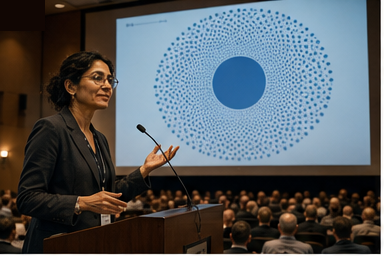
Aisha presents her 2022 paper — the overhead math makes fault tolerance impractical
Panel 1 of 14. Generate a wide-landscape graphic novel drawing with a width:height ratio of 16:9. Use rich colors in the style of a thoughtful, cinematic graphic novel — expressive character faces, dramatic lighting, environments that reflect emotional tone. Not cartoonish. Think Saga or Maus rather than superhero comics. Do not put captions or text in the image. Show Dr. Aisha Patel — a South Asian woman, early 40s, sharp eyes behind wire-rimmed glasses, a worn notebook covered in equations always within reach — at a conference podium. Behind her, a large projected slide shows a simple diagram: one circle labeled "logical qubit" surrounded by a thousand small circles labeled "physical qubits." The audience is attentive. Aisha's expression is the confident precision of someone presenting a result she stands fully behind. Color palette: the conference hall warmth, the projected blue-white of the slide, Aisha in composed command of her argument.Think of a logical qubit the way you think of a message you want to send across a noisy telephone line. The noise is constant. The message is fragile. One way to protect it is to repeat it — send it three times, take the majority vote. A qubit works the same way, except the noise is quantum and the repetition costs physical hardware.
In 2022, Aisha publishes the calculation that everyone in the field quietly knows but nobody has written cleanly: to protect one logical qubit using the best available error correction code — the surface code — you need between one thousand and ten thousand physical qubits. She puts the number on a single slide. "The overhead," she tells the conference, "is the problem. Not the physics. The arithmetic." The room nods. The paper is downloaded forty thousand times in six months.
Her conclusion is not that quantum computing is impossible. It is more precise: at current error rates and current code efficiencies, the overhead makes a useful fault-tolerant machine require more physical qubits than can be built on a single chip. The math, she argues, does not close. She is right about the math. She is working from the right data. What she does not yet know is that the data is about to change.
Panel 2: The Conference Bet
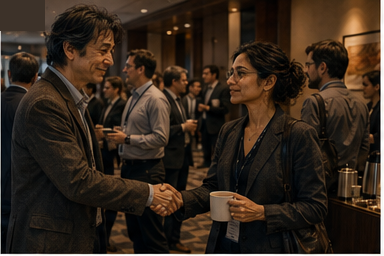
A colleague bets Aisha a bottle of wine that below-threshold operation will be demonstrated by 2025
Panel 2 of 14. Generate a wide-landscape graphic novel drawing with a width:height ratio of 16:9. Use rich colors in the style of a thoughtful, cinematic graphic novel — expressive character faces, dramatic lighting, environments that reflect emotional tone. Not cartoonish. Think Saga or Maus rather than superhero comics. Do not put captions or text in the image. Show the conference hallway afterward — a relaxed post-talk gathering near a coffee station. Aisha stands with a colleague — a tall man in his 50s, slightly rumpled, the kind of researcher who has been in the field since before it was fashionable. He is extending his hand for a handshake, a slight smile on his face. Aisha is accepting the handshake with the composed confidence of someone who believes they have just won a very easy bet. Neither is angry; this is a collegial wager between people who respect each other. Color palette: the warm corridor light, the casual energy of a post-talk coffee crowd, two people making a bet that will matter.Dr. Haruto Kimura has been working on quantum error correction since before it appeared in a single mainstream headline. He finds Aisha at the coffee station after her talk and extends his hand. "Below-threshold surface code operation," he says, "demonstrated on hardware, independently verified, published in a peer-reviewed journal. I say it happens by the end of 2025. You say it doesn't." Aisha shakes his hand without hesitation. "I say the overhead argument holds," she answers. "Below threshold is necessary but not sufficient. Even if they cross it, the qubit count required is still prohibitive."
The bet is a bottle of wine — the kind of small, serious currency that scientists use when they want a claim to cost something. Haruto writes the terms on a napkin and they both sign it. Aisha folds it and puts it in her notebook, next to the equations. She has no doubt about the outcome. The numbers she published two months ago are careful and correct. She did the math.
What neither of them says aloud, because it would be impolite: Haruto has seen this bet before. He was on the losing side of it twice — once on laser cooling, once on topological insulators. He has learned that in physics, the data has a way of moving faster than the theorists expect. He orders two coffees and says nothing about this.
Panel 3: Google Willow Lands
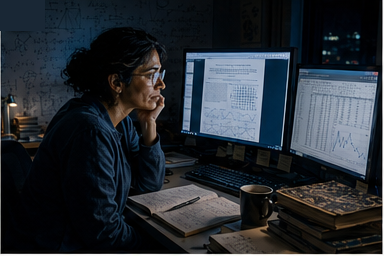
December 2024 — Aisha reads the Google Willow paper and opens a new spreadsheet
Panel 3 of 14. Generate a wide-landscape graphic novel drawing with a width:height ratio of 16:9. Use rich colors in the style of a thoughtful, cinematic graphic novel — expressive character faces, dramatic lighting, environments that reflect emotional tone. Not cartoonish. Think Saga or Maus rather than superhero comics. Do not put captions or text in the image. Show Aisha at her desk late at night, the room lit only by her monitor. On screen: a preprint notification. She is reading with the focused stillness of someone encountering a result they did not expect. A single number is visible in her mind — not on screen, in her expression: the suppression factor. She has already opened a spreadsheet in a second window. Her coffee is untouched. Color palette: the blue-white of the screen in a dark room, the quiet intensity of someone reading something that requires their full attention.The notification arrives on a Tuesday in December 2024. A new paper from Google's quantum hardware team: a surface code experiment on a processor called Willow. Aisha reads the abstract standing up. She sits down to read the methods section. She opens a spreadsheet before she finishes the results section.
The key number is called lambda — Λ. It measures whether the error correction is actually working. If Λ is greater than one, adding more physical qubits reduces the logical error rate. This is what "below threshold" means: the code is self-improving as you scale. Think of it like compound interest, but for reliability. Every time you increase the code distance — wrap the logical qubit in another protective layer — the error rate drops by a factor of Λ. Google's result: Λ = 2.14 on a distance-7 code using 101 physical qubits. Doubling the distance more than doubles the protection.
There is a second number Aisha writes on a notepad and underlines twice. The logical qubit — the protected, encoded qubit — outlived the best raw physical qubit on the same chip by a factor of 2.4. This has never been shown before. It means the encoding is not just theoretically helping. It is measurably outperforming the hardware it is built from. Aisha stares at the number for a long moment, then writes one word next to it: "recalculate."
Panel 4: The Curve Bends
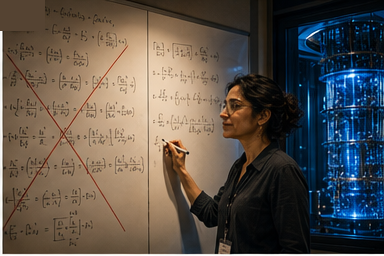
Aisha plots the error suppression data — her 2022 model used the wrong regime
Panel 4 of 14. Generate a wide-landscape graphic novel drawing with a width:height ratio of 16:9. Use rich colors in the style of a thoughtful, cinematic graphic novel — expressive character faces, dramatic lighting, environments that reflect emotional tone. Not cartoonish. Think Saga or Maus rather than superhero comics. Do not put captions or text in the image. Show Aisha at her whiteboard, drawing a graph by hand. The graph shows two curves: one bending upward (above threshold — adding qubits makes things worse) and one bending downward (below threshold — adding qubits makes things better). She is circling the lower curve. On the left side of the board, her 2022 equation is still visible. She has drawn a large arrow from it pointing to the graph. Her expression is not embarrassment — it is the precise, almost clinical recognition of a scientist who has found the exact location of her error. Color palette: the bright whiteboard light, the clean geometry of the two curves, Aisha's focused composure.The error in her 2022 paper is not in the arithmetic. The arithmetic is correct. The error is in the assumption about which side of the threshold the field was on. Her overhead calculation assumed above-threshold behavior — that adding more physical qubits would require increasingly heroic engineering to prevent errors from accumulating. Below threshold, the math inverts. Each additional layer of protection multiplies the benefit. The overhead number she published was accurate for a world in which the threshold had not been crossed. Google Willow crossed it.
She draws it on her whiteboard the way Feynman would have: two curves on a single graph, no equations at first. One curve bends up — above threshold, more qubits means more complexity and eventually more failure. One curve bends down — below threshold, more qubits means exponentially better protection. She labels them simply: "harder as you scale" and "easier as you scale." The entire field has been waiting twenty years for hardware to move from the first curve to the second. She draws a dot on the lower curve and writes "Willow" next to it.
The overhead calculation she published in 2022 is not wrong. It is the correct answer to the wrong question. She spent two years calculating the cost of building fault tolerance above threshold. Google just demonstrated it below threshold. Aisha sits down, opens her laptop, and starts a new document. At the top she types: "What does the overhead look like now?"
Panel 5: The qLDPC Shock
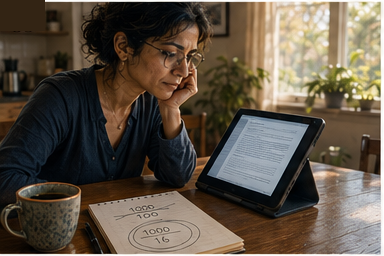
IBM's bivariate bicycle code encodes 12 logical qubits in 144 physical qubits — Aisha's overhead number drops by 10×
Panel 5 of 14. Generate a wide-landscape graphic novel drawing with a width:height ratio of 16:9. Use rich colors in the style of a thoughtful, cinematic graphic novel — expressive character faces, dramatic lighting, environments that reflect emotional tone. Not cartoonish. Think Saga or Maus rather than superhero comics. Do not put captions or text in the image. Show Aisha at her kitchen table on a weekend morning, reading a technical blog post on a tablet while her coffee goes cold. On a notepad beside the tablet she has written two fractions: "1/1000" crossed out, and below it "12/144." She is staring at the second fraction. Her expression is the quiet astonishment of someone doing simple division and not believing what they get. Color palette: the warm natural light of a weekend morning, the contrast of the cold coffee and the hot calculation on the notepad.The surface code is elegant but expensive. To protect one logical qubit, you spread its information across a grid of physical qubits and continuously measure the edges of the grid — not the qubits themselves — to detect errors without disturbing the quantum information. The grid needs to be large enough that errors are unlikely to cross it completely before being caught. This is why the overhead is high: a bigger grid means more physical qubits, and you get one logical qubit out of the whole grid.
IBM's qLDPC code — quantum Low-Density Parity-Check, pronounced by saying each letter — uses a different geometry. Instead of a flat grid, it uses a pattern of connections that wraps around like a torus — a donut shape. This topology allows long-range connections between qubits that are physically far apart, which means each physical qubit participates in protecting more logical qubits simultaneously. The result: IBM's bivariate bicycle code encodes twelve logical qubits into one hundred and forty-four physical qubits. Twelve out of a hundred and forty-four is one twelfth. The surface code would have required closer to one in a thousand.
Aisha does the division on a notepad and sits with the number. Her 2022 overhead argument was built on the surface code. She was not wrong to use it — it was the leading approach. But qLDPC codes had been a theoretical proposal, not a hardware reality. IBM has now demonstrated all the architectural components needed to run them. The overhead number she published has just dropped by roughly a factor of ten. She writes "revisit Section 3" in her notebook and underlines it three times.
Panel 6: Zuchongzhi Confirms
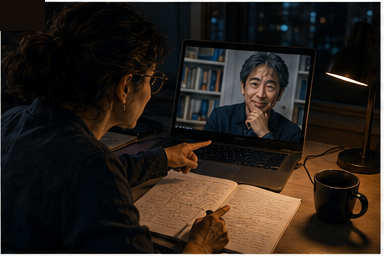
December 2025 — China's independent confirmation: different team, different architecture, same result
Panel 6 of 14. Generate a wide-landscape graphic novel drawing with a width:height ratio of 16:9. Use rich colors in the style of a thoughtful, cinematic graphic novel — expressive character faces, dramatic lighting, environments that reflect emotional tone. Not cartoonish. Think Saga or Maus rather than superhero comics. Do not put captions or text in the image. Show Aisha on a video call, leaning forward toward her laptop screen. On the screen: Haruto's face, clearly pleased but restraining his satisfaction. Aisha is pointing at something on a printed paper beside her laptop — the Zuchongzhi result. Her expression has moved from cautious re-examination to something closer to genuine conviction. The room behind her is dim, the call is happening late in her evening. Color palette: the blue-white of the video call, the warm desk lamp on the paper, the intimate quality of a late-night conversation between two people revising a shared understanding.Science does not run on single results. One experiment proving below-threshold operation could be a lucky configuration, a specific property of Google's hardware, a result that works in Santa Barbara but nowhere else. What the field needs is independent confirmation: a different team, a different machine, a different physical approach, arriving at the same answer.
In December 2025, a Chinese research group publishes results from a processor called Zuchongzhi 3.2: 107 qubits, a completely different leakage suppression architecture using only microwave pulses — no additional hardware, just careful pulse engineering — achieving an error suppression factor of 1.4 at code distance 7. The factor is smaller than Google's 2.14, but the direction is the same: below threshold, independently confirmed. Aisha calls Haruto the evening the preprint appears. "Two teams," she says. "Two different architectures. Both below threshold." Haruto says simply, "Yes." There is a pause. "I'll start looking for a good bottle," Aisha adds.
One confirmation can be a coincidence. Two independent confirmations, using different physical implementations, arriving at the same structural result — this is how physics crosses from interesting result to established fact. Aisha adds a new section to her draft revision: "The evidence now meets the standard for independent experimental replication." She has been trained her whole career to update on evidence. This is the evidence. She updates.
Panel 7: IBM Loon — Ahead of Schedule
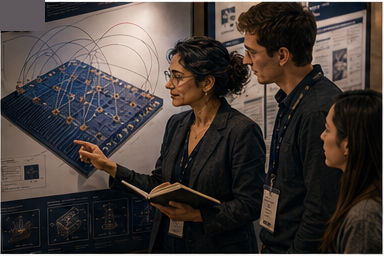
IBM's real-time qLDPC decoder runs in 480 ns — one year ahead of schedule
Panel 7 of 14. Generate a wide-landscape graphic novel drawing with a width:height ratio of 16:9. Use rich colors in the style of a thoughtful, cinematic graphic novel — expressive character faces, dramatic lighting, environments that reflect emotional tone. Not cartoonish. Think Saga or Maus rather than superhero comics. Do not put captions or text in the image. Show Aisha at an IBM research open day, standing beside a large technical poster. The poster shows a schematic of the Loon chip — long-range coupler connections drawn as arcs across a flat grid. A young IBM engineer beside her is pointing to the decoder timing spec. Aisha is writing in her notebook. Her expression is that of someone who came expecting incremental progress and is receiving something more substantial. Color palette: the clean white and blue of a research lab open day, the warm attention of two researchers examining a result together.Error correction has two parts. The first part is the hardware: physical qubits, gates, and measurements. The second part is the decoder: the classical computer that reads the measurement results, figures out where the errors are, and computes what correction to apply — all fast enough that the quantum information has not decohered before the correction arrives. This is like a spell-checker that works so fast the sentence is still in your mouth when the correction reaches your fingers.
IBM's Loon chip demonstrates a real-time qLDPC decoder operating in under 480 nanoseconds — roughly the time light takes to travel 150 meters. This is fast enough to keep up with the quantum hardware. IBM planned to demonstrate this in 2026. They demonstrate it in 2025. The chip also implements c-couplers: physical connections that link qubits across distances on the chip that go beyond nearest-neighbor, following the topology of a three-dimensional torus folded onto a flat surface. These long-range connections are what qLDPC codes require. They exist now in working hardware.
Aisha writes one line in her notebook: "The decoder bottleneck is resolved, one year early." In her 2022 paper, she identified three hard problems: overhead, threshold, and decoding speed. The threshold is crossed. The overhead has collapsed with qLDPC. The decoding speed is now demonstrated. She looks at the three lines in her notebook and draws a check mark next to each one. Then she stares at the checks for a long moment, because she is not someone who draws check marks carelessly.
Panel 8: The Multi-Core Analogy
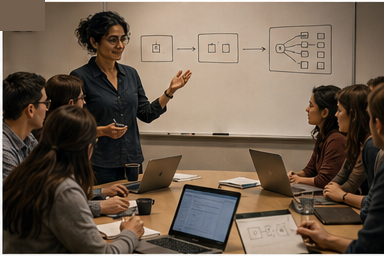
Aisha draws the classical computing parallel: single-core to multi-core to quantum modular
Panel 8 of 14. Generate a wide-landscape graphic novel drawing with a width:height ratio of 16:9. Use rich colors in the style of a thoughtful, cinematic graphic novel — expressive character faces, dramatic lighting, environments that reflect emotional tone. Not cartoonish. Think Saga or Maus rather than superhero comics. Do not put captions or text in the image. Show Aisha in front of her graduate seminar — six or seven students around a table, laptops open. She is at the whiteboard drawing a simple timeline: three boxes in a row. The first box has a small chip drawn inside it. The second box has two chips. The third box has a cluster of chips connected by lines. The students are engaged; one is writing rapidly. Aisha's expression is the pleasure of a teacher who has found the right analogy. Color palette: the bright seminar room, the clean whiteboard, the warm engagement of a small group learning something that clarifies rather than complicates.Here is the simplest way to understand what IBM is doing. In 1971, Intel's first commercial processor — the 4004 — put all the computing on a single chip. By the mid-2000s, chip manufacturers hit a wall: they could not make a single chip much faster without it generating too much heat and making too many errors. Their solution was not to make one perfect chip. It was to connect two ordinary chips and make them work together. Dual-core, then quad-core, then many-core. The fundamental limit of a single die was bypassed by making many dies into one system.
IBM's Kookaburra chip, planned for 2026, is the quantum version of this transition. Three separate quantum chips, each storing and processing encoded logical qubits, linked by chip-to-chip couplers and quantum communication channels into a single combined system of roughly 4,158 physical qubits. The chips behave as one processor. Aisha draws this on the board as three boxes connected by lines and labels the picture "the answer to the single-die problem." One of her students asks: "Is the entanglement preserved across the link?" Aisha nods. "That's what the l-coupler demonstration showed. The chips are not passing classical messages. They are sharing quantum information directly."
The modular approach is not a compromise. It is structurally superior to building one enormous chip, because fabrication defects and crosstalk — unwanted interactions between nearby qubits — both worsen as the chip gets larger. Smaller, higher-quality chips networked together give you scale without paying the quality penalty. The classical computing industry learned this twenty years ago. The quantum computing industry is learning it now, and learning it faster.
Panel 9: Ion Traps Join the Convergence
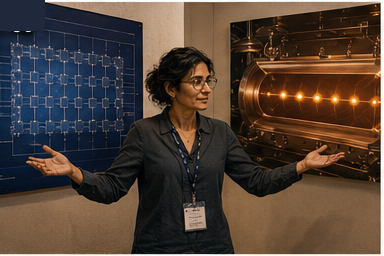
Two completely different physical platforms — superconducting and ion trap — arrive at the same modular architecture
Panel 9 of 14. Generate a wide-landscape graphic novel drawing with a width:height ratio of 16:9. Use rich colors in the style of a thoughtful, cinematic graphic novel — expressive character faces, dramatic lighting, environments that reflect emotional tone. Not cartoonish. Think Saga or Maus rather than superhero comics. Do not put captions or text in the image. Show Aisha at a conference poster session, standing between two posters on adjacent walls. The left poster shows a superconducting chip schematic — the IBM-style flat grid. The right poster shows an ion trap diagram — a linear chain of glowing dots, atoms suspended in a vacuum. Aisha has her arms slightly extended toward both, as if she is the link between them. Her expression is the quiet satisfaction of someone who has just recognized a pattern that was hidden until this moment. Color palette: the warm conference poster light, the left poster in the cool IBM blue, the right poster in the warmer amber of an ion trap, Aisha at the meeting point.A superconducting qubit is a tiny circuit cooled to a fraction of a degree above absolute zero, so cold that electricity flows without any resistance and quantum effects dominate. An ion trap qubit is a single atom — usually ytterbium or barium — suspended in midair by electric fields, laser-cooled to near stillness, and manipulated by precisely timed laser pulses. These are completely different physical systems. They fail in different ways, are built by different engineering teams, and operate at completely different temperatures and scales.
In 2024, Quantinuum's H2 ion trap system achieves a quantum volume — a combined measure of qubit count, connectivity, and gate fidelity — of over two million, and demonstrates twelve fault-tolerant logical qubits in a collaboration with Microsoft. In 2025, Oxford Ionics demonstrates 99.99% two-qubit gate fidelity — among the highest ever recorded in any quantum system. IonQ, after acquiring both Oxford Ionics and a photonics company called Lightsynq, publishes a roadmap for networking multiple ion-trap chips using photonic interconnects: light-based quantum links that pass entanglement between separate modules, targeting 1,600 logical qubits in a two-chip module by 2028.
Two different physical platforms. Two different error mechanisms. Two completely different engineering traditions. Both arriving independently at the same architectural conclusion: build small, high-quality modules and network them. When two different paths through very different terrain arrive at the same destination, the destination is probably real. Aisha writes this in her notebook as a single line: "Convergent independent confirmation of modular architecture."
Panel 10: The Milestone Scorecard
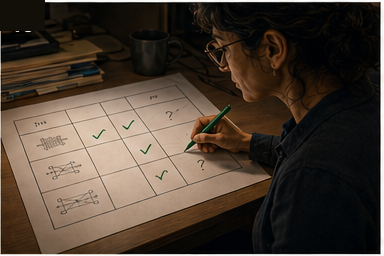
Aisha maps the milestone table against current results — three of five boxes checked
Panel 10 of 14. Generate a wide-landscape graphic novel drawing with a width:height ratio of 16:9. Use rich colors in the style of a thoughtful, cinematic graphic novel — expressive character faces, dramatic lighting, environments that reflect emotional tone. Not cartoonish. Think Saga or Maus rather than superhero comics. Do not put captions or text in the image. Show Aisha at her desk with a large printed table in front of her — five rows, three columns. She holds a green pen and has just made a checkmark in one cell. Two other cells already have checkmarks. Two cells have question marks. Her expression is careful and methodical — she is not celebrating, she is auditing. Color palette: the desk lamp warmth, the printed table crisp and formal, the green pen marks standing out clearly, Aisha's disciplined precision.Aisha keeps a personal version of the milestone table — the framework from her revised paper for what the field must demonstrate before fault-tolerant quantum computing is genuinely credible, not just theoretically possible. She updates it quarterly. Five categories. Three columns: required, current status, verdict.
Logical qubit quality — stable logical error rate below ten-to-the-minus-four per gate on ten or more logical qubits, reproducible across multiple platforms. Status: Google Willow and Zuchongzhi both confirm below-threshold operation. Quantinuum demonstrates twelve fault-tolerant logical qubits. She marks this green. Hardware reproducibility — two or more independent vendors confirming the same result. Status: superconducting and ion-trap systems, separate teams across three continents. Green. Hybrid quantum-classical workflows — quantum circuits integrated into classical computing pipelines with industrial partners. Status: IBM Nighthawk running alongside classical nodes, several industrial pilots underway. Green. Verified quantum advantage on a useful problem — peer-reviewed, not a benchmarking claim. Status: pending, expected 2026–27. Question mark. Algorithm readiness for the real applications — drug discovery, materials science, quantum chemistry — on fifty or more logical qubits. Status: not yet, but architecturally on-path for Starling class hardware in 2028–29. Question mark.
Three of five. She does not consider three of five a victory. She considers it the strongest evidential basis she has seen in her career for believing the remaining two are achievable on the projected timelines. This is a different sentence. She is careful about the difference.
Panel 11: The Wine
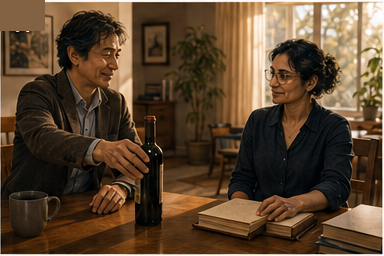
Haruto brings the bottle — Aisha asks to wait until Kookaburra ships
Panel 11 of 14. Generate a wide-landscape graphic novel drawing with a width:height ratio of 16:9. Use rich colors in the style of a thoughtful, cinematic graphic novel — expressive character faces, dramatic lighting, environments that reflect emotional tone. Not cartoonish. Think Saga or Maus rather than superhero comics. Do not put captions or text in the image. Show a faculty common room — the relaxed atmosphere of a late afternoon between meetings. Haruto sets a bottle of wine on the table in front of Aisha with the quiet satisfaction of someone who has waited a long time to do this. Aisha looks at the bottle, then at him, and then picks it up and sets it carefully to the side — not refusing it, deferring it. Her expression is precise: she is honoring the bet while adding one condition. Haruto is smiling. He respects the condition. Color palette: the warm common-room light, the bottle catching the afternoon sun, the unhurried quality of two scientists with a long bet finally settling.Haruto brings the bottle to the faculty common room on a Thursday afternoon in early 2026, the week the Loon results are published. It is a good Burgundy. He sets it on the table without ceremony. "Below threshold," he says, "independently confirmed, peer-reviewed." Aisha looks at the bottle for a moment, then at the napkin they both signed three years earlier, which she retrieves from her notebook. The terms are clear. She has lost the bet.
She picks the bottle up and sets it to one side. "I'll accept this in full," she tells him, "on the day Kookaburra demonstrates three chips operating as a single processor." Haruto raises an eyebrow. "The bet was about below-threshold operation," he says. "Which has been demonstrated." "Yes," Aisha says. "And the bet is yours. I'm not disputing that. I'm asking to wait one more milestone before we open it, because I want to drink it at the moment the modular architecture is proven — not before." Haruto considers this, then nods. He sits down. She sits down. They talk about the Loon decoder for an hour without opening the bottle.
This is not a stalling tactic. Aisha's revised paper has already updated her original conclusion. She has already told colleagues at two conferences that her 2022 overhead argument needs to be read in the context of hardware that did not exist when she wrote it. She is not defending a position. She is waiting for the right moment to mark it properly. Haruto understands this. He leaves the bottle on the shelf in her office when he goes.
Panel 12: Kookaburra Ships
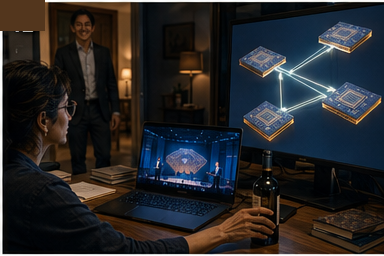
2026 — three chips operate as one — Aisha opens the wine
Panel 12 of 14. Generate a wide-landscape graphic novel drawing with a width:height ratio of 16:9. Use rich colors in the style of a thoughtful, cinematic graphic novel — expressive character faces, dramatic lighting, environments that reflect emotional tone. Not cartoonish. Think Saga or Maus rather than superhero comics. Do not put captions or text in the image. Show Aisha's office, evening. She is watching a livestream on her laptop — IBM's Kookaburra announcement. On a secondary monitor: a diagram of three chips linked by quantum communication lines, glowing faintly. The bottle of wine is on her desk. She is reaching for it. Haruto is visible in the doorway, having just arrived. Her expression is not triumphant — it is the quiet, earned satisfaction of someone who updated a belief correctly, on evidence, at the right time. Color palette: the blue-white of the livestream, the warm office lamp, the bottle catching both lights at once.IBM's Kookaburra announcement comes on a Tuesday in 2026. Three separate quantum chips, each independently storing and processing encoded logical qubits, linked by chip-to-chip couplers and quantum communication channels into a single unified processor of roughly 4,158 physical qubits. The three chips behave as one. Logical quantum information moves between them without re-encoding. Entanglement is preserved across the links. The modular architecture is no longer a roadmap item. It is a running system.
Aisha is watching the livestream when Haruto appears in her doorway. She does not say anything. She reaches for the bottle. He crosses the room and finds two glasses in the small cabinet behind her desk — he has been in this office many times and knows where they are. She pours. They watch the rest of the announcement standing, glasses in hand, and do not speak until the Q&A session begins. "Three chips as one processor," Haruto says finally. "The same principle as the dual-core transition." Aisha nods. "Except we built the interconnects first, instead of after."
The modular scaling breakthrough is, in her view, the most underappreciated result in the entire roadmap — more important, in the long run, than any single qubit count milestone. It means the fundamental question is no longer "can we build a big enough chip?" The question is now "can we build enough good small chips?" That is a manufacturing and engineering question. Those are questions humanity already knows how to answer at scale.
Panel 13: Starling on the Whiteboard
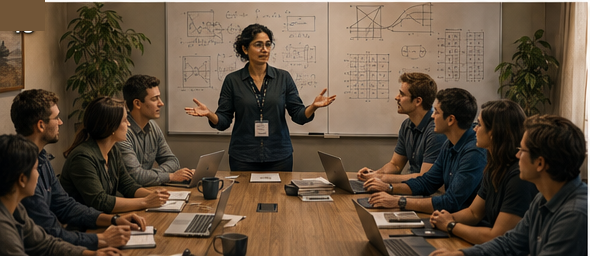
Aisha presents the forward roadmap to her group — 200 logical qubits, 100 million gates by 2029
Panel 13 of 14. Generate a wide-landscape graphic novel drawing with a width:height ratio of 16:9. Use rich colors in the style of a thoughtful, cinematic graphic novel — expressive character faces, dramatic lighting, environments that reflect emotional tone. Not cartoonish. Think Saga or Maus rather than superhero comics. Do not put captions or text in the image. Show Aisha's research group meeting — eight people around a conference table, her at the whiteboard. She has drawn a simple timeline with four points marked on it: now, 2027, 2029, 2033. At each point, two numbers — logical qubits and gate count. The students are engaged; one is drawing the same diagram in her notebook. Aisha's expression is the measured optimism of a scientist presenting a credible forward projection, not a wish list. Color palette: the research group meeting light, the whiteboard timeline clean and clear, the engaged attention of a room that has earned the right to think about what comes next.Aisha draws the forward roadmap on the whiteboard the way she draws everything: start with the simplest version, add complexity only when needed. Four points on a timeline. The first point is now — Kookaburra running, modular architecture demonstrated, three of five milestones green. The second point is 2027: IBM's Cockatoo chip, which entangles two Kookaburra modules using long-range microwave links between completely separate chips. Not linked qubits on one die. Separate modules, sharing entanglement over a distance. The architecture scales like nodes in a network.
The third point is 2029: IBM's Starling system, combining multiple such modules with magic state factories — specialized quantum circuits that generate the extra resource states needed for universal fault-tolerant computation. Two hundred logical qubits. One hundred million gates. At this scale, Aisha explains, certain quantum chemistry calculations that are currently intractable on any classical supercomputer become tractable on quantum hardware. The molecules relevant to drug discovery, battery design, and industrial catalysis sit in exactly this range of complexity. The fourth point is 2033: Blue Jay, targeting two thousand logical qubits and one billion gates.
A student asks the right question: "Is the roadmap credible, or is it a projection?" Aisha's answer is careful. "IBM has hit every major milestone in its published roadmap since 2019. Loon was demonstrated a year ahead of schedule. These are not aspirational claims. They are engineering commitments backed by hardware that is already running. I consider them credible — conditional on no unexpected physics emerging at scale that we haven't seen yet." She pauses. "Which is always the condition."
Panel 14: The Updated Paper

Aisha submits the revision of her own 2022 paper — citing herself to explain exactly what changed
Panel 14 of 14. Generate a wide-landscape graphic novel drawing with a width:height ratio of 16:9. Use rich colors in the style of a thoughtful, cinematic graphic novel — expressive character faces, dramatic lighting, environments that reflect emotional tone. Not cartoonish. Think Saga or Maus rather than superhero comics. Do not put captions or text in the image. Show Aisha at her desk, clicking the submit button on her laptop — the final action of uploading a paper. On the desk beside her: a printed copy of her 2022 paper with handwritten annotations in the margins, a few pages heavily marked. On her screen: the submission confirmation for the new paper. Her expression is the clean satisfaction of someone who has closed a loop — not with relief, but with the quiet pleasure of having done the work honestly from beginning to end. Color palette: the desk lamp warmth, the printed 2022 paper marked in pencil, the screen glow of the submission confirmation, the unhurried peace of work completed correctly.The title of the new paper is simple: "Revised Overhead Analysis for qLDPC Codes Under Modular Scaling: Why the 2022 Argument No Longer Holds." The abstract begins: "In a 2022 paper, one of the present authors argued that the physical-qubit overhead of surface codes made fault-tolerant quantum computing impractical at scale. Three developments — below-threshold surface code operation demonstrated independently by two groups, the bivariate bicycle qLDPC code reducing overhead by roughly one order of magnitude, and the modular chip-to-chip architecture sidestepping single-die fabrication limits — together invalidate the central premise of that argument. We present a revised overhead analysis and update the conclusion accordingly."
Aisha cites her own 2022 paper eleven times. Not to distance herself from it — it was correct for the data available at the time — but because the most precise way to explain what changed is to point to exactly where each assumption was made and show which new experimental result supersedes it. This is not a retraction. A retraction implies an error. There was no error. There was a model that fit the available data, and then new data arrived, and the model was updated. This is the mechanism by which science advances. She considers it the most important paper she has written, not because it is more sophisticated than the 2022 version, but because it required more honesty.
She clicks submit. The confirmation screen appears. She closes the laptop, picks up the printed copy of the original paper, and puts it in a folder labeled simply "superseded." She does not throw it away. The original argument was careful and well-reasoned and correctly interpreted the data of its time. It deserves to be kept. It just no longer stands as the final word.
Epilogue: Aisha did not change her mind because someone pressured her, or because the field became fashionable, or because she had grown optimistic. She changed her mind because three independent experimental results each addressed a specific assumption in her original argument, and the arithmetic came out differently. The threshold was crossed. The overhead collapsed. The chips began linking. Science does not reward stubbornness or credulity — it rewards the willingness to redo the calculation when the data changes. She did the math again. The math said something new.